Written by Goh Young
Translated by Hwang Jongwook
“It's just a simple diner with no fancy food. I don't know what else I'm supposed to say,” the co-owners of Dooriban, Mr. Yoo Chae-rim and Ms. Ahn Jong-nyeo, reluctantly said as the interview began. The word, which they define as a simple diner, is bapjip—a combination of two staple Korean words: bap (food or dinner) and jip (house). The term itself means “home-style diner.” Its reverse, jipbap, means “home fare.”
Despite the owners' modesty, Dooriban is a popular spot for casual yet satisfying lunches and dinners among neighborhood residents and office workers—a place that truly lives up to the owners' self-described bapjip. The food here often draws cries of “delicious!”, but the meaning of that word is different from the praise reserved for lavish meals at an upscale restaurant. The couple specializes in two dishes—kalguksu, a typical Korean noodle dish, and bossam, steam-cooked belly of pork—but other dishes like hotpot, dumplings, and fresh-made jeon (assorted pan-fried fritters) are also beloved. One regular, an office worker named Kim, says he feels at ease when dining there, whether alone or with his 43-month-old child.
“It's comfortable. My kid enjoys the dishes like bossam, kalguksu, and gamjajeon —fried potato pancake— , and I feel safe feeding them. Kids won't put anything in their mouths unless it’s clean and full of flavor. Their mouths are the most honest. They immediately know when food is too salty or not fresh. They like freshly made side dishes and don't care for the ones that have been sitting around for a day.”
A meal in a bapjip is all about food that doesn't feel heavy and pleases children's palates. Even with an already reliable main dish and several humble but flavorful side dishes, a guest here might be tempted to add yet another à la carte item from the menu. The steamed meat, for instance, stands well on its own, and the typical accompaniment, kimchi, lacks any exaggerated sweetness or spiciness. This simplicity is a departure from a more common bossam that features an array of flavorful additions; it appears hearty at first glance but lacks a focus on the harmonious pairing of the meat and kimchi.
“It's humble food and I just love it,” another regular interrupts. “When it comes to fried chicken, you eventually get tired of all the seasonings and realize that ‘the good chicken house is where you have the best fried chicken with nothing more,’ right? That’s exactly what Dooriban's food is like.” The people sitting around smiled and nodded in agreement.
At 1:00 PM, the owner couple have no time to rest. They are busy greeting guests, cleaning tables, and processing payments. Mr. Yoo is in charge of serving, while Ms. Ahn runs the kitchen. It isn't until 3:45 PM, when there are fewer customers, that the Dooriban crew can finally have their own late lunch. The owners finally had time for a face-to-face conversation with the interviewer as they finished their meal.
“I started this to make a living, obviously.” Mr. Yoo, born in 1960, is a novelist who made his debut as a young aficionado of literature and still aspires to complete his own masterpiece. As one might easily imagine, being a writer was no walk in the park, and the financial pressure of raising two boys made it even tougher. However, an opportunity arose when his eldest brother offered him a spot for a 24-hour restaurant in his sauna. That's how they started in the food business. From 2001, for two and a half years, the husband managed the front of the restaurant while the wife worked in the kitchen. During this time, Ms. Ahn learned the fundamentals of running a restaurant and discovered her cooking skills. “I was skilled enough to imitate right away even if I learned it over my shoulder. I also have a good sense for seasoning,” Ms. Ahn said with a chuckle.
Ms. Ahn's mother was a celebrated maker of tteok—a Korean rice cake dish—within her community. Her tteok, prepared with rice flour and various toppings in a traditional earthenware steamer, was a must-have at every neighborhood event. There is a Korean saying that goes, “one who presses a mold on one's tteok even when it's going to be eaten right away,” which refers to someone who puts great care into their work, even for something fleeting. Her mother was one such person, and it was from her that Ms. Ahn inherited her culinary skill. For Mr. Yoo, however, the restaurant business was more of a struggle. The 24-hour schedule didn't allow him any time to write, and more often than not, he was forced to sweet-talk customers—something he had never done in his life. “I have never treated people that way,” he admitted. “It was never easy to think like a restaurant owner. As a matter of fact, it still isn’t.”
After years of hard work, the couple saved up a considerable amount of money. They gained more experience at a relative's restaurant before finally taking over the establishment, opening their first restaurant in March 2005. The exact address, 167-31 Donggyo-dong, Mapo-gu, Seoul, is a number long carved in their memories. As their life stabilized, Mr. Yoo briefly left the restaurant business to work as the head of a publishing department at the Center for Missionary Education of the Korean Presbyterian Church, finally finding time to write at least a few lines.
However, the couple's joy was short-lived. “In 2008, two years and ten months after opening, we were blindsided by a lawsuit related to a redevelopment project,” Mr. Yoo explained. “We lost the store without getting a dime.”
The trouble began with the groundbreaking of the Incheon Airport Express construction project. A new station was planned for the bustling Hongdae district, sparking a reconstruction boom for neighboring buildings, including the one where the couple’s restaurant was located. The owner sold the building to a construction enterprise that decided to demolish it, forcing the tenants, including the Dooriban couple, out onto the street. The company filed a lawsuit demanding their eviction and offering next to nothing for their investment. The tenants fought back in court, but to no avail. One by one, they succumbed to the pressure, leaving the couple to stand alone against the big corporation.
Then, on December 24, 2009—Christmas Eve—employees of a private security company forcibly demolished Dooriban. They threw out Ms. Ahn, who was guarding the store at the moment. Two days later, on December 26 at 2 AM, the couple broke through the security fence and began a sit-in that would last for one year and six months.
“As we were tearing down the fence to get in, my wife said, ‘I cannot let go of this place like this. Live or die, I'll go with my store. You take good care of the kids.’ It was like a will to me,” Mr. Yoo recalled. “But we still hold onto that same spirit that inspired us to start this business, fight for our store, and continue our passion for running a bapjip.”
Fortunately, other evicted residents and numerous artists from the neighborhood joined the fight in a show of solidarity. Their collective action became known as the Dooriban Struggle, the biggest fight against gentrification in Korean history. The fight ended when the company finally decided to settle with the couple and offered them compensation that allowed them to reopen their restaurant. The new Dooriban opened on December 1, 2011, at 370-5 Seogyo-dong, Mapo-gu, Seoul.
Now entering 14 years in business as of 2025, the couple is enjoying the hard-earned time of simple pleasure-the steady rhythm of a kitchen. “A fight is a fight, but I genuinely enjoy working in the kitchen. Otherwise, how could one stay at the store for 12 hours every day except Sunday?” Ms. Ahn cheerfully said.
For her, that simple pleasure comes from the meticulous craft she developed from the early days of Dooriban, particularly for her dough, which serves as the basis for kalguksu and dumplings. She worried her suggestions might be seen as unnecessary nitpicking by the kitchen staff. Despite this, she persevered in her quest to perfect the unique flavor of Dooriban. To achieve the desired elasticity, she experimented with different techniques, making the dough relatively thick and boiling the noodles slightly longer. She also made fine adjustments to the recipe depending on the weather and season, such as during the summer and winter.
“My way of making dough for kalguksu is simple: 5 kg of flour, 2 tablespoons of salt, and water. That's it. I don't use any additives. In the summer, I let the dough ferment for one to one and a half hours, while in the winter, it takes about 3 hours. The dough should have the right consistency—not too watery or too hard. There's more than just keeping time and following exact measurements to achieve that. I pay close attention to the temperature, humidity, and condition of the dough on a given day, adjusting the process accordingly based on the taste I have in mind. The greatest joy is when the dough turns out just right and customers appreciate my kalguksu. It feels like all my hard work is rewarded.”
At first glance, it's easy to mistake Dooriban's dumplings for “rolled dumplings.” This is a technique where the stuffing is rolled in flour or starch and parboiled before wrapping. However, unlike common dumplings with a thicker wrapping, Dooriban's dumplings have a much thinner, almost transparent wrapping, clinging perfectly to the stuffing. Yet, Ms. Ahn and her staff don't actually roll their dumplings in this way, even though they look and taste like they do.
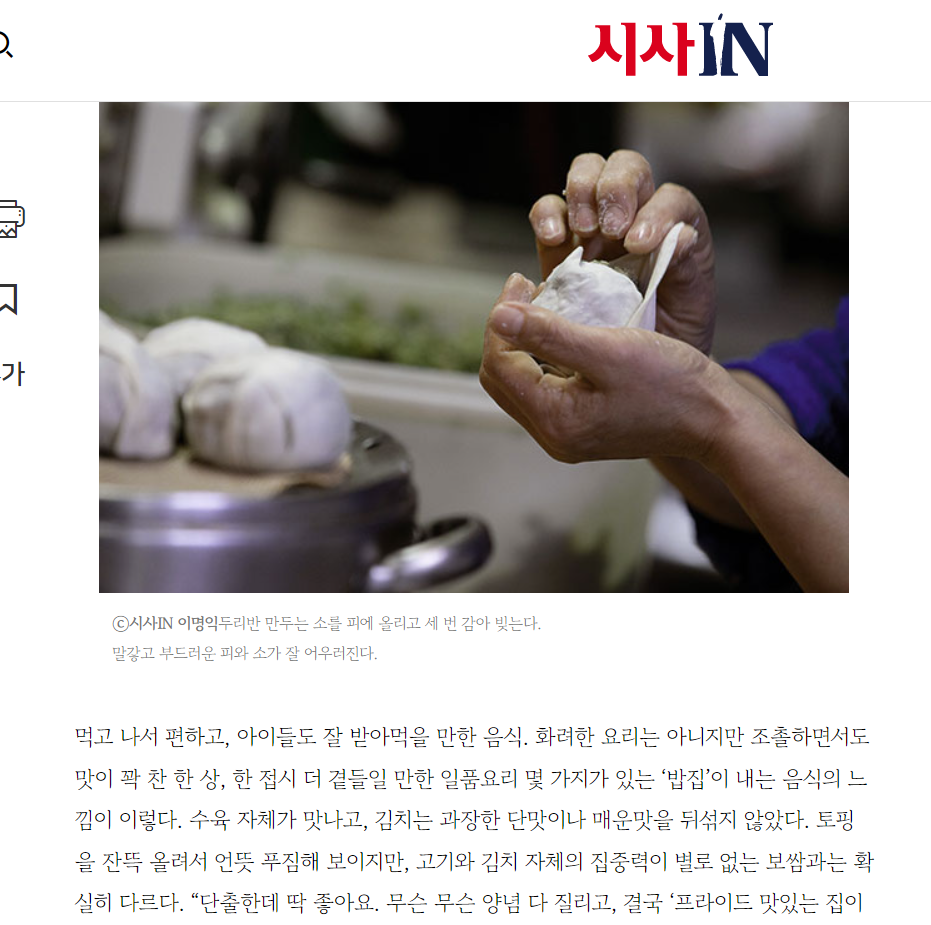
Ms. Ahn explains her technique: “I make the dough slightly moist so the wrapper can expand well. I place the stuffing on the wrapper, then envelop it in three quick pulls, bringing the ends together. Initially, I used to make it like I make songpyeon (Korean rice cakes eaten during the Harvest Festival), by bringing all the sides together, but I realized that took too much time. So, I developed my own method of shaping the dough and wrapping the filling. That's the fun part of working in the kitchen.”
Last but not least is her signature bossam. Facing budget constraints, Ms. Ahn must use imported frozen meat to serve generous portions, so she devotes considerable effort to defrosting it and draining excess liquid. She then relies on her own judgment and preferences when tenderizing the meat, believing that over-tenderizing can make it limp and brittle. To Ms. Ahn, a good steamed pork should have a balance of both softness and elasticity, with its flavor left intact.
As she elaborates, “It’s important to trim and boil the meat to achieve that balance of softness and elasticity. For the boiling process, I use only the root of green onion, pepper, and ginger. You must resist the temptation to use other spices to mask the meat's flavor; the meat should taste like meat. The accompanying kimchi should be crunchy, so I go to the market and mix my own several times a day to ensure its freshness and the perfect seasoning.”
All the discoveries and rewards of the work can't erase the fact that it's exhausting; they're in the store for 12 hours a day, and their total workday stretches to 14 hours. The working hours are too long, Mr. Yoo admits. If we want to take care of our health, we need to reduce our working hours. But we can't stop serving lunch and still call ourselves a bapjip. To do so, we'd have to hire additional staff, which means we'd be obliged to raise our prices to make ends meet.”
If they stop serving lunch and instead operate from 6 PM to midnight, with a focus on cooking and drinking, the owners can still manage to get by. However, they are determined that Dooriban should stay a bapjip, and if they give up lunch service, they give up their identity as a bapjip. The biggest pain is the lack of rest; the only respite is a drink after work.
“The only time I have to myself is when I have a drink alone. My husband doesn't drink, so he doesn't even have that kind of moment,” Ms. Ahn mused. “I really can't go without a can of beer every day. It's the only time of the day I have to myself, and it's the only time I feel relaxed. If only I could work 8 hours a day, I'd be able to get some rest and try other leisure activities besides drinking.”
The Dooriban owner couple still remember when a 20kg bag of flour cost 16,000 won (around 15 dollars); now, it costs 80,000 won (around 75 dollars). To keep up with these rising prices, they've realized they have no choice but to raise their food prices. This would allow them to reduce their working hours and still make a profit. The sale of a bowl of kalguksu, after all, makes less margin than that of a bottle of beer. “Since we are just a couple running a simple diner, we don't claim to have all the answers,” Ms. Ahn reflected. “We'd like to return the question to our customers—what do you think is a fair price for the food?”
As the interview drew to a close, the interviewee became the interviewer, leaving the latter speechless. In the kitchen, the staff worked diligently to prepare for the 5 to 10 PM service. Mr. Yoo and Ms. Ahn each had their own tasks to complete. Another 14-hour workday began. Dooriban, the bapjip, was carrying the weight of these tough questions facing society as a whole.
이 블로그에 새로 글을 쓰게 된 이유이기도 한 번역이다. 처음 한영번역을 시작하면서 일종의 연습 텍스트로서, 음식문헌연구자 고영 선생님이 시사인에서 진행한 '한국음식의 최전선'이라는 인터뷰 시리즈를 일부 번역했다. 고 선생님은 (나를 비롯하여) 글을 좋아하는 분들이 많은 만큼, 영어로 옮기기 쉬운 문장을 구사하시는 편은 아니다. 그럴 때 번역자가 해야 할 일은 한국어의 말맛을 흉내내는 과정으로 성급하게 넘어가기 전에, 문맥적 의미를 최대한 자세하게 분석하고 필요하면 문장의 리듬 자체를 어떻게 바꿀 것인지를 고민해야 한다. 글 전체에서 변주되는 '밥집'의 의미가 영어 독자들에게 와닿게 하기 위한 고민이 깊었다. '별 것 없는' 식당, 편안한 음식을 가진 식당, 주변 거주자들에게 사랑 받는 식당, 점심을 포함하여 '밥'을 주는 식당, 특히 마지막 부분은 비한국어화자에게는 이해하기 어려운 부분이리라. 아무튼 그 모든 것들을 포괄하는 하나의 establishment로서의 '밥집(bapjip)'이 형상화되는 것이 이 글의 고갱이리라고 생각한다.
'이미 꽉 찬 한상에 메뉴에서 한 두 개의 요리를 더 시킬 수 있게 하는' 음식의 힘, '세 번 감아 만드는 만두' 역시 쉽지 않은 지점이다. 후자의 경우에는 실제로 두리반에 가서 사장님이 만두를 만드시는 모습을 보고서야 알아차릴 수 있었는데, 그렇다 하더라도 (한국인에게는 익숙할) 만두 빚는 법과는 약간 다른 그 방법을, 그리고 그것이 '어떻게 다른가'를 전달하는 것 역시 번역자로서의 몫이다. 나는 이럴 때 그냥 선을 넘어 버리는, 다시 말해 미주알고주알 설명하는 쪽을 택했다. 또 '한 상'의 경우, 한국인에게야 한식은 '한 상'이라는 이야기가 설명이 필요 없는 전제적 사실이지만, 외국인들에게는 낯선 이야기이니(게다가 그게 음식의 '편안함'에서 비롯하는 것이라니!), staple과 side dishes로 이루어진 한 상을 설정해 준 다음에 거기에 메뉴를 더한다고 말해야 한다. '한 상'이라는 표현을 여기에서 살리려고 하면 그 순간 이 대담에 등장하는 인터뷰어와 두리반 사장님, 손님들과 독자 사이에 없던 심리적 거리감이 바로 생겨날 수 밖에 없다.
비록 서교동으로 내려온 이후부터이긴 하지만 그래도 두리반은 내가 좋아하는 밥집이고 또 그 음식이, 젠트리피케이션 투쟁의 선봉에 있었다는 그 상징성과 잘 맞아 떨어지는, 성실하고 선량한 맛을 자랑한다. 이 글이 그냥 한국에 온 외국인들에게 '홍대'라고 하는 곳에서 한때 벌어졌던 생존의 투쟁과(해당 부분은 원문에 없고 내가 가필한 부분이다) 그 만두 맛을 소개해 주는 기회가 되었으면 하는 바람이다.
'번역 (한국어 > 영어, 불어)' 카테고리의 다른 글
| Epitaph I (0) | 2025.09.17 |
|---|---|
| Hollyhock (0) | 2025.09.10 |
| Pine Mushroom (0) | 2025.09.08 |
| Dumplings (0) | 2025.09.07 |