Written by Goh Young
Translated by Hwang Jongwook
“Is it okay if I refer to you as 'head cook'?” I asked. A small smile touched his lips, a brief break in his demanding workplace. “Sure,” he said. “I don't like being called 'shep'—the Korean pronunciation of 'chef'—either.”
In the quiet hours between 3 and 5 p.m., when the staff at Gogiri Jangwon Makguksu in Yongin-si, a suburb of Seoul, changes the water for the noodles and eats their late lunch, owner-head cook Yoo Soo-chang finally had time to spare. But even during this brief recess, the door remains open. When new customers arrive, they're asked to wait, as the pot is empty and no noodles can be boiled until it's full again.
“If you ask me what a time-honored shop is, I say, right here,” once remarked a gastronomic writer Park Chan-il, another restaurateur who prefers to call himself 'head cook.' The praise from a peer is a powerful testament to the restaurant's holistic quality and completeness. It's among the most popular noodle joints, lauded by professionals and gourmets alike—a place where some even claim they go to once they've “graduated” from naengmyeon, traditional cold noodle delicacy known for its sophisticated nuance.
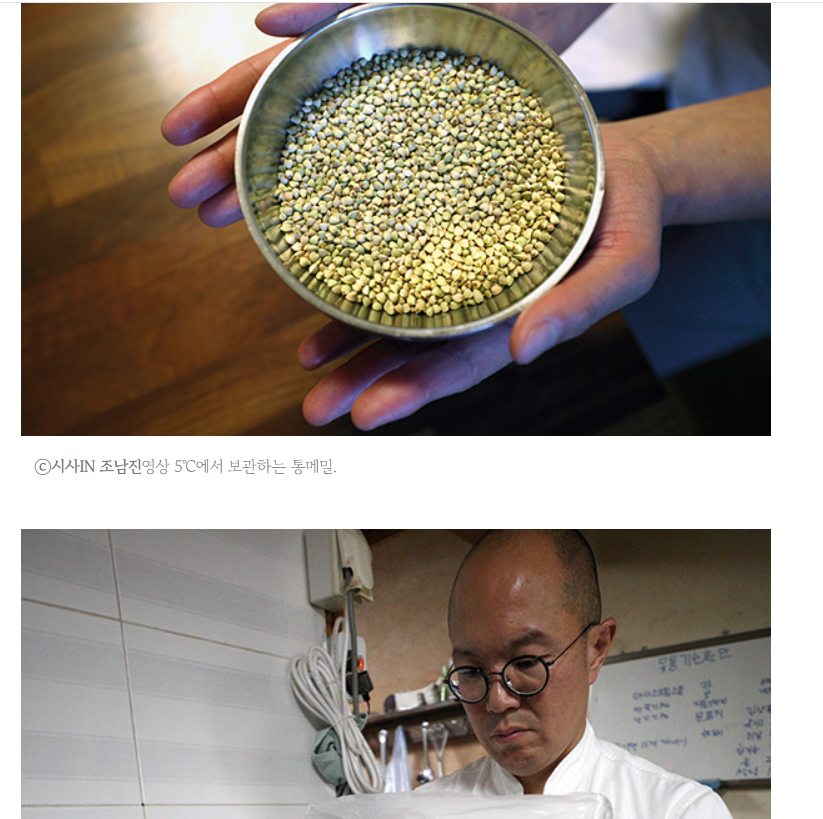
In a world of media-driven hype and fabricated reputations, I was keen on finding a place that had earned its praise the old-fashioned way: through authentic, uncompromising food. As I sat with Mr. Yoo, one of the first things I noticed was his pruney hands. The entire process of making a bowl of buckwheat noodles seems to require his touch, from extruding the noodles to boiling, rinsing, and plating them. It's a cycle that keeps his hands wet for at least 300 days a year.
Mr. Yoo majored in Economics at college, graduating in 1991. He then went to Japan for graduate school, where he discovered a view of the culinary world that was a stark contrast to the one he had known in Korea. The eye-opening experience inspired him to study culinary business in the Graduate Division of Commerce from 1995 to 1999.
“Everything was different in Japan. The old restaurants carried their own prestige, while small neighborhood stores exuded dynamism and personality. Those who could cook well were highly regarded and respected in society.”
Back in Korea, however, things were different. The restaurant business was often looked down on, and owners of even the most time-honored establishments would often close their doors rather than pass down their legacy. At the same time, countless copycat restaurants mimicking foreign establishments seemed to sprout up everywhere. It was right before the disastrous IMF crisis, during which many businesses collapsed. “How could they possibly replicate the prestige and personality, don’t you think?”
As he spoke of “prestige and personality,” he met the interviewer's gaze. Guided by all he had learned and felt during his graduate studies, he resolved to enter the culinary business himself. After a training period, he opened Niwa, an izakaya in Seoul’s bustling Apgujeong-dong district in 2001. At the time, Japanese-style restaurants serving the likes of yakitori (Japanese skewers) had not yet become a popular trend, making Niwa one of the first of its kind.
Running a menu with dozens of dishes was not easy for this rookie pub owner. He had to manage over 300 different types of ingredients and prepare ten different sauces without the convenience of pre-made products. The workload was grueling, and while customers were generally pleased with the menu, dealing with intoxicated patrons was a constant challenge. Moreover, though he initially served as a manager and didn't even pick up a knife, he had to take on the role of head cook himself when the head chef resigned.
“Even after I took charge of the kitchen, the business ran smoothly. But I began to feel a nagging doubt that never left me,” he said.
A wave of anxiety about his future washed over him as he wondered if he could keep up the pace past sixty and what legacy he would leave behind other than that of a mediocre pub owner. He yearned to be recognized as a culinary artist in his own right, rather than an assembly-line cook turning out carbon-copy bar food. As the mental and physical demands grew, he found himself lost in a cycle of work and rest, feeling a growing disconnect from his original vision.
On closing days, he would take excursions to the tranquil, mountainous province of Gangwon-do with his wife, Kim Yun-jung. The couple found peace in the region's quiet landscapes and indulged in their shared love for noodles, particularly the buckwheat specialty served in chilled broth or with a spicy sauce called makguksu. The vague idea of one day running a traditional Korean noodle restaurant, began to take root in his mind.
In 2011, he began to act on his idea, learning the necessary techniques at a celebrated noodle joint named Jangwon Makguksu in Hongcheon, a city in the Gangwon-do region. A fateful event, however, would add a new sense of urgency to his plans. The same year, while he was shopping at a large wholesale market, he was involved in a minor traffic accident. He went to the hospital for a check-up, and it was there that he was diagnosed with early-stage colorectal cancer. Spurred by this experience, he swiftly opened his restaurant at its current location in May 2012.
“I guess that’s why people say ‘luck decides’,” he chuckled. “If it hadn't been for the accident, how would I have even thought of taking the time to go to the hospital? Since then, I have never missed an annual cancer screening. With my health restored, I was able to organize my life without any regrets and truly get ready to make some makguksu.”
And so their fourteen-year journey began. The couple readily admits to having consumed at least 250 bowls of makguksu each year, making it a bowl for almost every single working day. For them, eating the dish daily is a necessary part of perfecting it for their customers, knowing that for many, a bowl of makguksu in the restaurant is often their first in a long time. “Guests are entitled to savor the best quality on every visit, especially on their first one,” Mr. Yoo asserts
With each serving of noodles consisting of 300 grams, a single piece of dough makes seven servings of noodles. Mr. Yoo claims to taste a difference in flavor and texture between each bowl. In other words, he can tell the subtle variations between the first four and the final three bowls. “It's something we've just come to know,” he said. “Ms. Kim and I naturally have to be more sensitive than our customers. I’ve consumed countless bowls of noodles here, and my goal is to serve only the crème de la crème.”
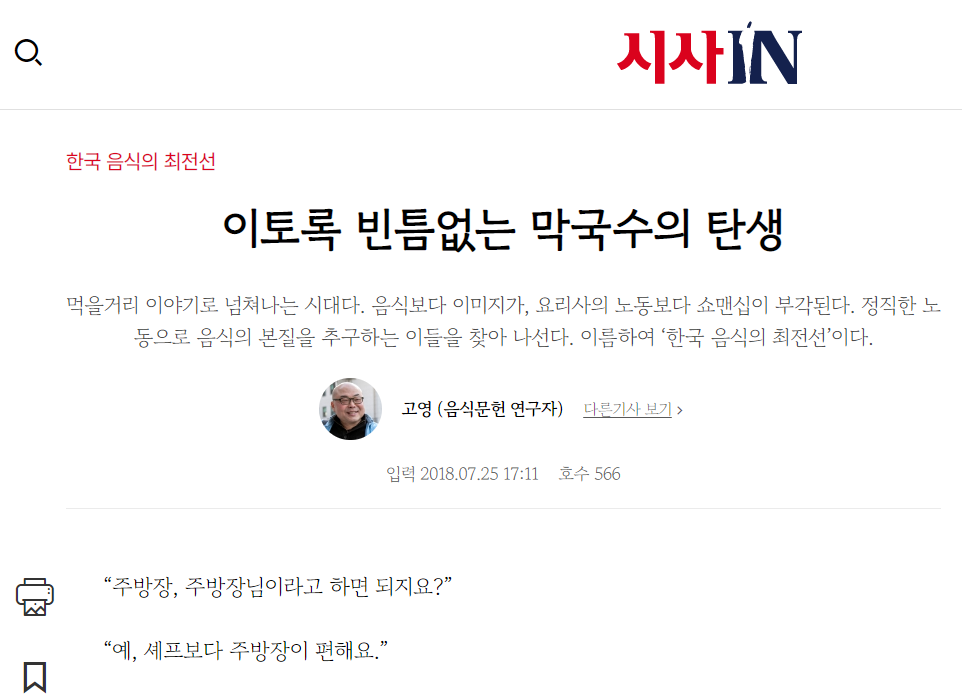
At this point, Mr. Yoo excused himself and left the room. A moment later, he returned with a bowl of whole buckwheat, its light green hue a distinctive feature.
“The buckwheat has a genuine nutty, toasty scent,” he said. “If you don't use it right after grinding, it's impossible to capture that aroma in the sari (noodles). The noodles made with freshly ground buckwheat and those made with buckwheat left for a day—or even three—differ significantly, with the aroma quickly disappearing. To serve good sari with the desired aroma and color, you must first ensure good quality whole buckwheat. Store it properly at 5 degrees Celsius until you grind it, mill it on the same day, knead it, and put it in the mold right away. You also have to mill it in small, frequent amounts, because the mill overheats when large quantities are processed, causing the aroma to disappear. In a word, the more work you do in the kitchen, the better the quality of the noodles will be.”
Mr. Yoo seemed somewhat unsatisfied to know that the genuine aroma of buckwheat cannot be captured in words. “Take a handful of these grains and take a deep breath. Can you smell the aroma?” he said, before bringing out the commercial dried noodles he had prepared for the staff meal. “Now try this!” he exclaimed as a different smell, that of baking soda, a common dough enhancer, filled the air. “This is the smell of pan cakes,” I replied. We looked at each other, exchanging a knowing smile.
There are customers who have not yet experienced the aroma of buckwheat with its distinct nutty and toasty taste, and others who consider the flavor of the dough enhancer to be that of buckwheat, claiming that the noodles in the restaurant have a faint scent. To them, he cannot help but engage in what he jokingly calls “myeonsplaining,” a playful blend of myeon (noodle) and mansplaining.
“For kneading and milling alone, I do it ten to twelve times a day,” he said. "I arrive at work and start grinding buckwheat at 9:30 AM, and by 10:00 AM, I am making the first dough. After the staff meal at 10:30 AM, we open the restaurant at 11:00 AM. This is what it's like in this restaurant 300 days a year.”
Another specialty of the restaurant is suyuk, or steamed pork. It needs to be put into boiling water by 9:30 AM so that it can be served when the restaurant opens at 11:00 AM. He never boils all the meat he needs at once. Instead, he boils it four to six times a day, whenever it's needed, and lets it steam for 30 minutes before serving.
“There's just no other way,” he said. “You have to work and move more. You can still make a flavorful makguksu without using a dough enhancer or kneading the dough in hot water. The secret lies in a few simple steps: use quality ingredients, mill in small amounts, and knead the dough whenever needed instead of letting it rest in a large portion. When it's done properly, the boiling water itself used to make the noodles even exudes the nutty, roasty flavor of buckwheat.”
“It is a prejudice that sari made of buckwheat should be dark, rough, and soft enough to be cut even with one's gums,” Ms. Kim, general manager of the establishment, adds. The technology of shelling and milling the grain has advanced dramatically. While it is true that buckwheat flour has less elasticity than wheat flour, it has its own unique strength, allowing its dough to hold for a certain period of time.
“The flavor of properly produced buckwheat sari, the appearance of good buckwheat that has been thoroughly peeled, and the savory taste of well-milled buckwheat,” Mr. Yoo said. “All these traits distinguish buckwheat noodles from wheat flour ones. As more customers become aware of these qualities, the entire industry will grow, won't it?
“My recipe for broth? Beef bone, kelp, radish, green onion, onion, garlic, and that’s it. It should be light and refreshing to complement the flavor of the buckwheat sari. The marinade should be aged for two weeks. All these things are common knowledge for every noodle restaurant in the country. There's no such thing as a secret recipe.”
“Yet I love coming to work every day,” Mr. Yoo added. “You need to hold sari, rinse it, and plate it daily to get a feel for it. It took me a full year to develop my own routine. That's how I made my restaurant a workplace I would recommend to my own kids.”
The couple has two daughters, who are in the third grade of middle school and the fifth grade of elementary school, respectively. According to Ms. Kim, their daughters told their homeroom teacher that they want to own their own noodle restaurant in the future. The parents are fully behind this idea..
“Of course they should own their own noodle shop!” Mr. Yoo exclaimed. “I've worked so hard, and I would regret it if they didn't want to do it. The restaurant I envy the most is the one where three generations of a family come to eat together. It's a place where the people working there become part of the scenery.” He grinned and added, “I want to become part of the scenery at our restaurant. I want to play with the noodles, be it for 10 or 20 more years.”
This simple phrase—wanting to become a part of the scenery—captured the entire philosophy I had come to understand. It represented a dedication so profound that the work itself becomes a natural part of the world around it. His well-constructed routine is as constant as the rhythm of his own life, and in that consistency, the head-cook and the manager, not just proprietors, become a living part of the restaurant's scenery.
역시 "한국음식의 최전선" 인터뷰에 실렸던 인터뷰이다. 고기리 막국수는 가고 싶은 만큼 자주 가지는 못하는 곳이지만, 어쩌면 그렇기 때문에 갈 때마다 마음을 다잡게 되고, 나올 때마다 새로움을 찾게 되는 곳이다. 한국음식의 깊이를 알 수 있는 곳에 대한 기록을, 기쁘게 옮겨 보았다.